

The Peak Cluster Carbon Capture and Storage project has created significant public comment, with much of the opposition centring around the impact on ecology and habitats. While it is fair to say that comparisons to other projects such as HS2 do not bear much scrutiny (this would be a buried pipeline like gas and some electricity), there will be impacts, particularly where above-ground infrastructure is involved, and these impacts should be given as much attention as possible.
As always, we stress that Moorlands Climate Action does not have a group view on whether the benefits of the Peak Cluster project for climate targets outweigh its many costs. Instead, we seek to guide Moorlanders to as many sources of information as possible, in order that they may make up their own minds. This article attempts to set out the framework in which ecological impacts will be considered.
From the Cauldon site (where there would be a large CCS plant) the pipeline is planned to stretch to Leek, where it swings around to the north, and then out across the Moorlands to Cheshire. The indicative corridor for the line went out to the public in the first round of consultation in January 2026. While the final route of the line itself will not take up the whole of the corridor, and there may be alterations within the corridor, it is unlikely, in the Moorlands at least, that there will be any significant changes to the route itself arising from the consultation. This is an infographic of how they will build the pipeline.
Matters are complicated by the existence of another major pipeline project in the Moorlands. Severn Trent Water plans to build a connection from Carsington Water in Derbyshire to the Tittesworth Reservoir and Water Treatment Plant (the ultimate source of the water is the complex of reservoirs in the Dark Peak that supply the Derwent). This long-awaited project is essential to guarantee adequate future water supplies for Tittesworth in the face of climate change and a stricter ground abstraction regime.
Where it hits the Moorlands, the pipeline will run along a (mostly) similar corridor to the Peak Cluster project, with the fit being particularly tight as they arc around the top of Leek. Though managers at both projects are fully aware of the existence of the other, they inevitably compound the effect of each other.
The Severn Trent pipeline will be constructed to a different timetable and several years in advance of the Peak Cluster. Permission will be sought under the ‘permitted development’ regime, which allows utilities to build connections, whether for electricity, telecoms or gas.
We understand that the application for the Severn Trent pipeline is about to come to Staffordshire Moorlands District Council. While the pipeline will be buried (except perhaps where it crosses a major watercourse) and so won’t leave a permanent scar, it will have some ecological impact. We understand the planned line has already been swerved to avoid SSSIs south of the Ashbourne-Leek road. As soon as we have a map similar to that for Peak Cluster, we will make it available.
But back to Peak Cluster itself. The project spans three Wildlife Trusts: Staffordshire, Cheshire and Derbyshire. Cheshire Wildlife Trust has been the most forward in its reaction to the project, producing this detailed response, including a commentary on Peak Cluster’s Environmental Impact Assessment Scoping Report. It’s clear from this that there will be significant impacts on the Cheshire leg, including the fact that the coastal project infrastructure is planned for the tip of the Wirral, a highly congested and contested landscape with a number of sensitive wildlife sites. (It is also home to the Wirral Wildlife Trust, a subsidiary of the county-wide Trust with a long history of campaigning.)
Cheshire’s prominence in the debate likely reflects that the Trust also has significant experience of dealing with industrial and transport projects (the Dee and Mersey estuaries are traditional home to a complex of energy-intensive industries and already has the Hynet hydrogen/carbon capture project).
Neither the Derbyshire nor the Staffordshire Trusts have yet produced stand alone reports on the ecological effects of the project, though both are involved in the consultation process.
It is probably fair to say that Peak Cluster’s approach to this, as in other aspects of the consultation, has been legally pristine and strictly to-the-letter, but very much on their terms and to their own timetable. While every landscape is sensitive to those who live in and near it, the pipeline’s ecological impact is arguably less significant in the Moorlands than along some other sections.
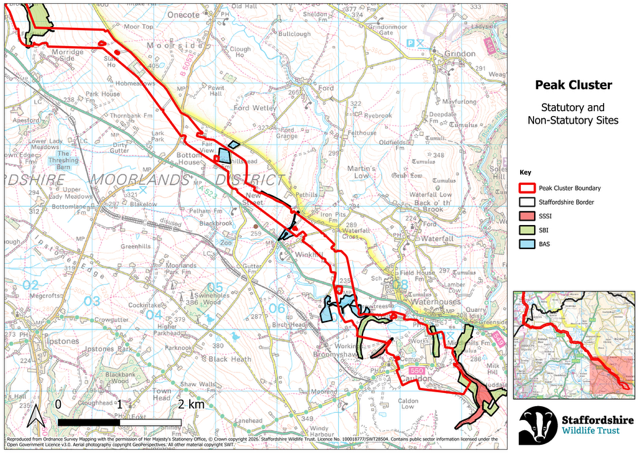
That’s not say it will have no impact: as the accompanying maps show, while there are no Sites of Special Scientific Interest on the route, at the plant itself it comes very close to the Cauldon SSSI sites. (SSSIs are in theory, if not always in practice, the gold standard for conservation management.)
Likewise, the Cauldon end of the project clearly sits on two Sites of Biological Importance. These are non-statutory designations but are still regarded as significant enough to be considered in planning decisions. For example, two more SBIs sit on the route beyond Leek.
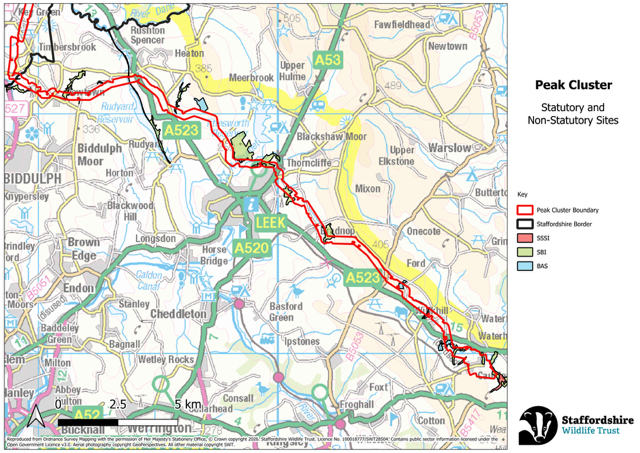
Though the accompanying maps do not include Semi-Ancient Woodland it seems that at least two such areas in the Moorlands may be affected. The Peak Cluster project will be classed as a Nationally Significant Infrastructure Project, meaning that the ultimate decision will be taken by the Secretary of State. The government recently made any projects applying for consent after November 2026 liable for Biodiversity Net Gain.
BNG is intended to compensate for ecological or habitat damage by requiring a measurable increase of at least 10% in overall biodiversity value. It is a clunky and rather mechanical process but when managed properly it can translate into real enhancement.
The new Staffordshire Local Nature Recovery Strategy is now effectively in place, and however badly the County Council have managed the process (and they have managed it badly) it provides a tool to direct the BNG funds that the project will throw off to the place where they will make the most ecological difference.
Peak Cluster already has its own in-house person responsible for BNG, and we now understand that it may be about to appoint an external body to advise on its BNG programme. With Cheshire Wildlife Trust’s knowledge and experience, and the work they have already put in, they could be the favourite for this role, though they would need to ensure that they are seen by the public to maintain their independence. If Cheshire Wildlife did fill this position, they would doubtless work closely with the Derbyshire and Staffordshire Trusts.
But given the strength of the feeling aroused on the Wirral, and the fact that, unlike in Derbyshire, the Staffordshire leg of the project would not stretch through the Peak District National Park, there is always the danger that the focus might be elsewhere. This might be an opportunity for local community groups in the Moorlands to make sure that eyes remain firmly fixed on any ecological impact on this district. And that any improvements to habitats (and community funds) destined for here are delivered as wisely as possible. Informed local knowledge is vital.